PEI Ferry vs Confederation Bridge: Which Should You Take?
If you are driving to or from Prince Edward Island, you essentially have two main choices: cross the Confederation Bridge between New Brunswick and PEI, or take the Northumberland Ferry between Nova Scotia and PEI.
Grace and I have done both multiple times.
I was born and raised on Prince Edward Island and lived there for 26 years before moving to Ontario. We still return every year, and some years we make the trip more than once.
On one recent visit, we entered PEI across the Confederation Bridge and left aboard the Northumberland Ferry. That gave us a fresh opportunity to compare the two experiences back-to-back.
And the answer to "Which one is better?" is not quite as simple as bridge versus ferry.
It depends on where you are travelling, how much time you have, your budget and whether you want the journey itself to become part of your PEI experience.
Watch our full comparison below, then keep reading for the costs, travel times, pros and cons, and which option I personally choose most often.
PEI bridge vs ferry at a glance
Confederation Bridge | Northumberland Ferry | |
|---|---|---|
Connects PEI with | New Brunswick | Nova Scotia |
PEI location | Borden-Carleton | Wood Islands |
Mainland location | Cape Jourimain, New Brunswick | Caribou, Nova Scotia |
Crossing time | About 10 minutes | About 75 minutes |
2026 standard vehicle cost | C$20 when leaving PEI | C$43 reserved vehicle fare + fuel surcharge |
Passengers included? | Vehicle toll | Yes, with reserved vehicle fare |
Reservation needed? | No | Strongly recommended for guaranteed boarding |
Operating season | Year-round | Seasonal |
Schedule | 24 hours a day | Set sailing times |
Best for | Speed, flexibility and price | Experience, scenery and relaxing |
Our practical choice | Confederation Bridge | — |
Our more memorable choice | — | Northumberland Ferry |
Prices, fuel surcharges, schedules and travel policies can change. Always verify current information with the bridge or ferry operator before travelling.
First: where are you coming from?
Before comparing prices or experiences, look at your route.
The Confederation Bridge connects Borden-Carleton, PEI, with New Brunswick.
The Northumberland Ferry connects Wood Islands, PEI, with Caribou, Nova Scotia, near Pictou.
That means geography may make the decision for you.
If you are driving from Ontario, Quebec, New Brunswick or through the Moncton area, the bridge is usually the natural way to reach PEI.
If you are coming from Halifax, Cape Breton or another part of Nova Scotia, the ferry may fit more naturally into your route.
That said, you can absolutely drive from Nova Scotia into New Brunswick and use the bridge instead.
We have done that too.
So geography matters, but it is not the only consideration.
Option 1: The Confederation Bridge
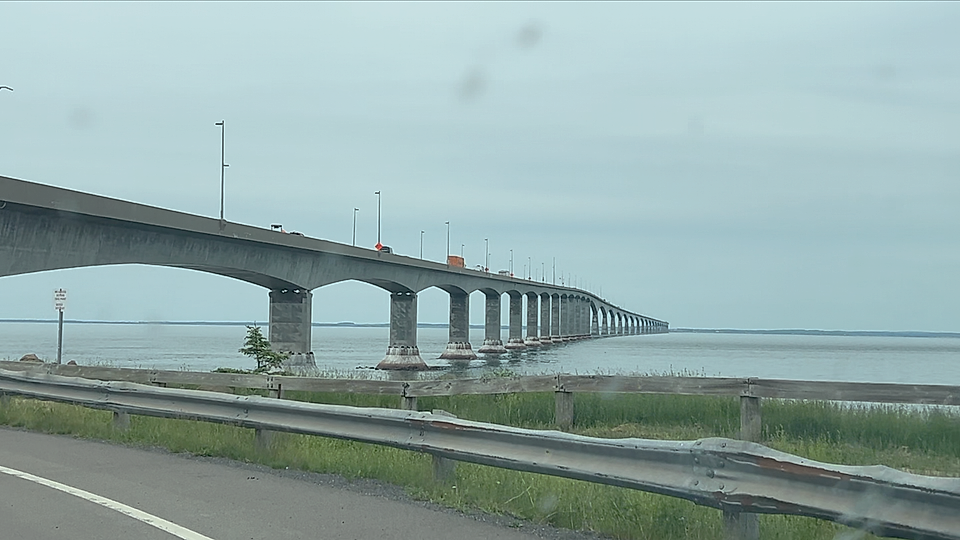
The Confederation Bridge connects Prince Edward Island with New Brunswick across the Northumberland Strait.
The curved bridge is 12.9 kilometres long and holds the distinction of being the longest bridge in the world crossing ice-covered water. It opened to traffic in 1997.
Under normal driving conditions, the crossing takes approximately 10 minutes.
It operates 24 hours a day, 365 days a year, and you do not need a reservation.
For most of our PEI trips, that convenience is extremely difficult to beat.
How much does the Confederation Bridge cost?
As of 2026, the toll for a standard vehicle with its first two axles is C$20.
The toll is collected when you leave Prince Edward Island, regardless of whether you originally entered using the bridge or ferry.
That C$20 toll is considerably lower than it used to be.
The passenger-vehicle toll had been C$50.25 before the federal government reduced it to C$20 beginning August 1, 2025.
Entering PEI from New Brunswick therefore feels free at the time because you do not stop at a toll booth until travelling in the opposite direction.
Pros of taking the Confederation Bridge
It is fast. This is the biggest advantage. You drive onto the bridge, spend roughly 10 minutes crossing and continue your trip. There is no need to arrive 40 minutes early or organize your day around a departure time.
No reservation is required. You can decide to cross whenever you arrive. That flexibility becomes especially valuable during a long road trip. Traffic around Toronto, Montreal or elsewhere can change your arrival time by hours. With the bridge, that generally does not matter.
It operates year-round. You do not have to worry about ferry season. The bridge is available 24/7, 365 days per year under normal operating conditions.
It is currently cheaper. At C$20 for a standard two-axle vehicle, the bridge is currently the less expensive option.
It works well for spontaneous travel. You do not need to know exactly what time you will arrive in Borden-Carleton or Cape Jourimain. Just drive. For me, this is a major advantage.
Cons of taking the Confederation Bridge
There is not much of an "experience". This may sound unfair because the Confederation Bridge is an impressive engineering achievement. But from a traveller's perspective, you are still basically driving down a road. Ten minutes later, you are on the other side. There is no opportunity to leave the vehicle, eat, stretch your legs or spend time looking over the water.
The views can be limited from a smaller vehicle. This surprised me when I first started crossing the bridge regularly. The concrete barrier along the side is approximately 1.1 metres high. The bridge operator specifically notes that people in taller vehicles, including some full-size SUVs, vans, trucks and buses, get a better view over the barrier. In a regular car or lower SUV, you may see considerably less than expected. When travelling in something taller, such as an RV or larger truck, the crossing becomes much more visually impressive.
Wind can affect some vehicles. The bridge is designed to operate in difficult Maritime weather, and complete closures are rare. However, high winds can result in restrictions, particularly for high-sided vehicles, motorcycles and vehicles towing trailers. Anyone travelling with a camper or RV should check current bridge conditions before approaching.
Make the bridge more of an experience
One way to make the bridge crossing more memorable is to stop at Cape Jourimain on the New Brunswick side.
We have done this during our Ontario-to-PEI road trips.
From there, you can get a much better appreciation of the scale of the Confederation Bridge before actually driving across it.
Seeing nearly 13 kilometres of bridge disappearing across the Northumberland Strait is considerably more impressive than staring at the concrete barrier from your driver's seat.
Option 2: The Northumberland Ferry
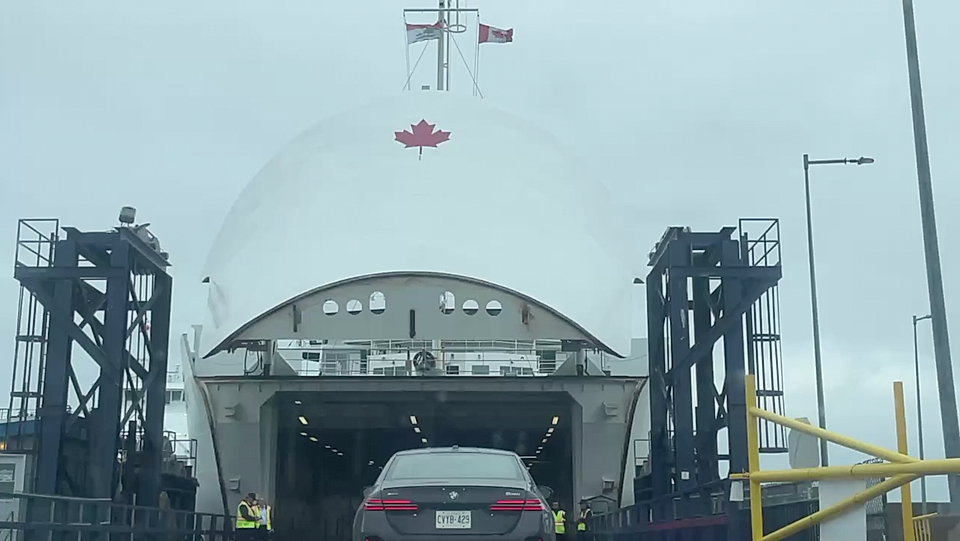
The other main option is Northumberland Ferries, travelling between Wood Islands, Prince Edward Island, and Caribou, Nova Scotia.
This feels completely different.
Instead of treating the crossing simply as transportation, you drive onto a ship, leave the vehicle and spend approximately 75 minutes crossing the Northumberland Strait.
You can walk around. Sit down. Get something to eat. Use the washroom. Go outside. Watch PEI disappear behind you or appear ahead.
The ferry turns travelling between provinces into part of the trip.
How much does the PEI ferry cost?
For 2026, Northumberland Ferries lists a C$43 reserved fare for a standard vehicle up to 20 feet long and seven feet high, with passengers included.
Vehicles under 20 feet also currently have a C$2.50 fuel surcharge, bringing the standard posted cost to approximately C$45.50 under those conditions. Larger vehicles and trailers fall into different fare categories.
Always check current pricing when booking because rates and fuel surcharges can change.
Do you need to reserve the PEI ferry?
This is one detail I want to clarify from our video.
A reservation is strongly recommended, but it is not necessarily the only way to travel.
Northumberland Ferries encourages reservations and uses them to guarantee space on your preferred sailing. Standby travel may be available depending on capacity and vehicle type.
Personally, I would reserve.
When I am building a vacation itinerary around a ferry departure, I do not want to arrive at the terminal hoping there is space.
Arrive early
The ferry requires more planning than the bridge.
Vehicles with reservations are expected to be checked in and available for boarding at least 40 minutes before departure.
If you are not checked in at least 20 minutes before departure, Northumberland Ferries can cancel the reservation and move you to the wait list.
So even though the crossing itself takes 75 minutes, the real time commitment is longer.
You need to account for:
- Driving to the terminal
- Early check-in
- Waiting to board
- The 75-minute sailing
- Unloading afterward
This is not the quick option.
Pros of taking the ferry
The ferry is an experience. This is the biggest advantage. Instead of remaining behind the wheel, you get to leave the vehicle and enjoy the trip. That can be especially nice after several hours of driving.
You get a proper break. A long road trip becomes tiring. The ferry forces you to stop. You can sit somewhere comfortable, stretch your legs and let someone else handle transportation for a while.
There are washrooms and food. You have amenities available during the crossing rather than needing another roadside stop.
The views are much better. There is no concrete barrier beside your window. You can go outside and look across the Northumberland Strait. On a nice day, the water and coastline make the ferry substantially more scenic than the bridge.
It feels like part of a Maritime vacation. There is something distinctly East Coast about taking a ferry between Prince Edward Island and Nova Scotia. If you have never done it, I think it is worth experiencing at least once.
Cons of taking the ferry
It takes considerably longer. This is the main reason I do not personally choose it most of the time. A 75-minute sailing plus early check-in turns the crossing into a meaningful part of your day. The bridge takes about 10 minutes.
You are tied to a schedule. This matters on road trips. If traffic delays you on the way to the ferry terminal, your problem is not simply that you arrive later at your destination. You could miss your sailing.
It costs more. For a standard vehicle, the ferry currently costs more than twice the C$20 bridge toll once the fuel surcharge is included.
Service is seasonal. Unlike the bridge, Northumberland Ferries does not provide a 24/7, year-round crossing. Sailing schedules vary throughout the season, including how many departures operate each day. Always check your dates before assuming the ferry will be an option.
Weather can affect the schedule. This is Atlantic Canada. Weather happens. Sailings can be delayed, revised or cancelled, and the operator publishes current travel advisories when conditions affect service.
Confederation Bridge vs Ferry: side-by-side
Here is how I would compare them for most travellers.
Category | Confederation Bridge | Northumberland Ferry |
|---|---|---|
Speed | Winner | Much slower |
Price | Winner | More expensive |
Flexibility | Winner | Tied to sailing times |
Reservations | None | Recommended |
Year-round access | Winner | Seasonal |
Views | Limited from some vehicles | Winner |
Ability to stretch your legs | No | Winner |
Food/washrooms during crossing | No | Yes |
Experience | Interesting engineering | Winner |
Road-trip convenience | Winner | Requires more planning |
Relaxation | You keep driving | Winner |
That is really the entire decision in one table.
The bridge wins on practicality.
The ferry wins on experience.
Which should you take from New Brunswick?
Take the bridge.
If you are already travelling through New Brunswick, particularly from Moncton, there is usually very little reason to complicate the journey by driving into Nova Scotia simply to use the ferry.
The Confederation Bridge takes you directly from New Brunswick onto PEI.
It is faster, cheaper and requires no reservation.
Which should you take from Halifax?
This is more interesting.
If you are travelling between Halifax and PEI, the ferry can fit naturally into the route.
You travel north toward Caribou, board the ferry and arrive at Wood Islands on PEI's eastern side.
That makes sense particularly if eastern PEI is already part of your itinerary.
However, you can also continue toward New Brunswick and use the Confederation Bridge.
And personally?
I still often lean toward the bridge.
Even when travelling toward Halifax, I like the flexibility of simply driving without needing to organize the entire day around a ferry departure.
What about Cape Breton?
If your trip includes Cape Breton, the ferry becomes more appealing.
Geographically, travelling between eastern PEI and northern Nova Scotia can make the Wood Islands-Caribou crossing a logical part of the route.
This is where I would look more carefully at actual driving times rather than automatically choosing the bridge.
The right answer depends heavily on where you are staying before and after the crossing.
What if you are driving from Ontario?
For us, this is simple.
Confederation Bridge.
Our annual drive from Windsor to PEI takes us through Ontario, Quebec and New Brunswick.
We pass through the Moncton area and continue toward the bridge.
Using the ferry would mean changing our route simply to experience the ferry.
We generally do not do that.
Our separate 2,052 km Windsor-to-PEI road trip guide covers the full route, including our overnight stop in Quebec and our favourite stops along the way.
Enter one way and leave the other
For a first PEI trip, this might actually be the best answer.
You do not necessarily have to choose.
If your wider Maritime itinerary allows it:
Enter PEI across the Confederation Bridge and leave aboard the ferry.
Or do the opposite.
That gives you both experiences.
You get to drive across one of Canada's most impressive bridges and also experience a Northumberland Strait ferry crossing.
This works particularly well for someone doing a larger Maritime road trip involving New Brunswick, PEI and Nova Scotia.
You are not doubling back simply for an attraction.
The two crossings become part of your route.
That is exactly what we did on one of our recent trips.
Which is better with kids?
I would probably give the ferry the advantage if time and schedule are not major concerns.
Seventy-five minutes outside the car can be a welcome change during a long family road trip.
Kids can move around rather than remaining strapped into a vehicle.
There is also simply more happening.
The bridge is over before you know it.
Which is better with an RV or camper?
This requires more planning.
The Confederation Bridge remains simple, but high-sided vehicles and vehicles towing trailers can be subject to wind restrictions during poor conditions. Check the bridge's current travel advisories before arriving.
On the ferry, vehicle pricing depends on dimensions. The 2026 fare structure has separate categories for trailers, campers and vehicles over 20 feet.
Do not assume your motorhome or tow vehicle will receive the standard passenger-vehicle fare.
When travelling with something larger, I would check both operators before deciding, including current vehicle classifications and weather restrictions.
Which option do I personally choose?
The Confederation Bridge.
Without much hesitation.
And I say that as someone who genuinely enjoys the ferry.
From a purely practical standpoint, the bridge wins for me because it is:
- Faster
- Cheaper
- Open year-round
- Available around the clock
- Reservation-free
- Easier to incorporate into a long drive
I do not need to predict exactly when we are going to reach Borden-Carleton.
I do not need to worry about missing a departure.
I do not need to arrive 40 minutes early.
I just drive.
After making the Ontario-to-PEI trip as many times as we have, simplicity matters.
But the ferry is more memorable
This is the important caveat.
If someone asked me which crossing is the more enjoyable travel experience, I would say the ferry.
You get out of your vehicle.
You walk around.
You see the water.
You can eat something.
You get fresh air.
For 75 minutes, the journey becomes part of your vacation instead of simply the road connecting two destinations.
We recently took it again after using the bridge to enter PEI, and I was reminded how enjoyable it is.
I just would not choose it solely because I need to get somewhere quickly.
Our final recommendation
Here is the simplest way I can put it.
Take the Confederation Bridge if:
- You want the fastest option
- You want the cheapest option
- You do not want to make a reservation
- Your arrival time is uncertain
- You are travelling outside ferry season
- You are coming through New Brunswick
- You simply want to get to PEI
Take the Northumberland Ferry if:
- You are travelling through Nova Scotia
- You are heading toward Halifax or Cape Breton
- You want the crossing itself to be an experience
- You want a break from driving
- You do not mind planning around a sailing time
- You want better water views
- You have never taken it before
And if your route allows it:
Take one each way.
For a first-time Maritime road trip, that gives you the best of both.

My choice after years of travelling to PEI
I grew up on Prince Edward Island.
Grace and I return regularly.
We have crossed by bridge.
We have crossed by ferry.
And neither option is bad.
If I am thinking purely about transportation, I will choose the Confederation Bridge almost every time.
It is difficult to argue with 10 minutes, C$20 and no reservation.
But travel is not always about finding the quickest way from Point A to Point B.
Sometimes you have time to slow down.
And when you do, taking a ferry across the Northumberland Strait, walking onto the outdoor deck and watching PEI come into view is a pretty great way to begin a trip.
Or end one.
So don't overcomplicate it.
Choose the bridge when practicality matters.
Choose the ferry when the journey matters.
And if you have the time and route to experience both?
Even better.
Before you go, check current details: Tolls, fares, fuel surcharges, schedules and policies can change. Verify current details with the Confederation Bridge and Northumberland Ferries before you travel.